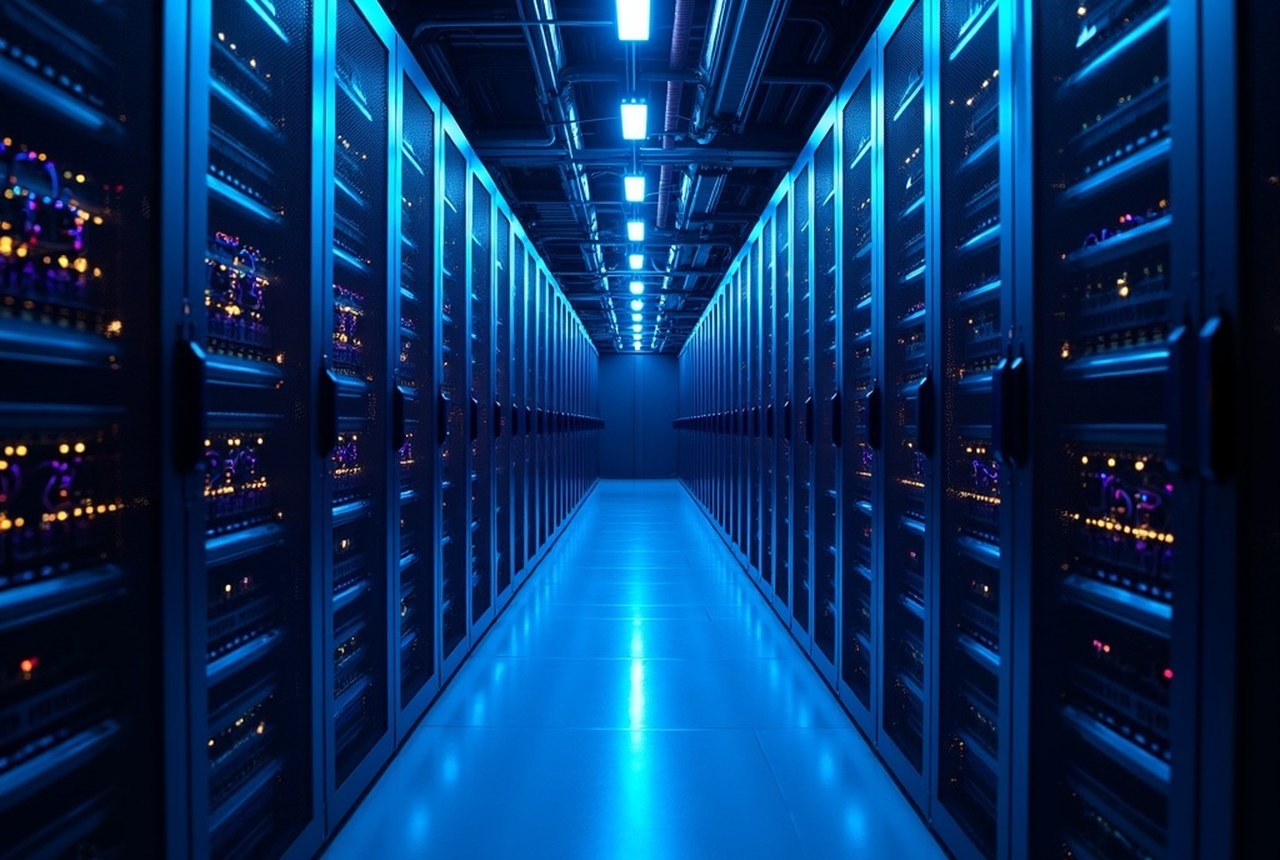
From Commodity Cabinet to Critical Infrastructure
For most of data-center history, the rack was an afterthought — a steel frame, forty-two rack units tall, built to a standard dating back decades. Engineers chose servers; they chose networking; the rack was just the scaffolding that held everything together. A typical cabinet drew perhaps five to ten kilowatts, and commodity air cooling handled the rest. The enclosure itself required little engineering imagination.
That comfortable assumption is now obsolete. A modern AI training node — a server carrying eight high-end GPUs plus the NICs, memory and local flash needed to keep them fed — can draw roughly ten to fourteen kilowatts on its own. Fill a rack with those nodes and you are looking at forty to over a hundred kilowatts per cabinet, an order of magnitude beyond the old baseline. Rack density at this scale transforms the enclosure from a passive organizer into a precision thermal and electrical system. Structural load ratings, cable management geometry, power-bus capacity and cooling integration all have to be re-engineered from scratch.
The shift matters because the rack is the smallest repeatable unit of a data center's power and cooling architecture. Get it wrong and you cannot simply patch the problem at the facility level — you create hot spots that throttle GPUs, unplanned downtime, and stranded capacity that is expensive to recover. Every kilowatt of heat that cannot be extracted reliably is compute that cannot run.
Every kilowatt of heat that cannot be extracted reliably is compute that cannot run.
What a Modern Rack Actually Has to Do
At AI-cluster densities, passive airflow is rarely sufficient. Racks destined for GPU-heavy workloads increasingly ship with provisions for direct-to-chip liquid cooling — cold plates that carry chilled water or a water-glycol mix directly to processors rather than relying on fans pushing air across fins. Some deployments go further still, moving toward immersion cooling, where entire servers are submerged in a non-conductive dielectric fluid. Both approaches demand that the rack enclosure accommodate manifolds, hose penetrations and fluid-management hardware alongside conventional cabling — a very different design brief from the standard ventilated steel box.
Power delivery inside the rack has grown equally demanding. High-density AI nodes often use 48-volt direct-current power distribution rather than the legacy 12-volt bus, reducing resistive losses across the longer conductor runs that dense configurations require. Busbar systems rated for tens of kilowatts per cabinet are replacing daisy-chained PDUs. Cable management — both copper and fibre — must be engineered so that the dense InfiniBand or high-speed Ethernet runs connecting GPUs to the network fabric can be routed without blocking airflow or impeding servicing.
Structural engineering matters too, and in a way that is easy to underestimate. An eight-GPU AI server can weigh well over fifty kilograms. A full rack of them, plus switches and power hardware, may approach a tonne. Floor loading limits that were never a constraint for web-server deployments suddenly become a site-planning constraint, particularly in retrofitted or colocation facilities not originally designed for this kind of mass.

The Selection Decision
None of this makes the rack market monolithic. Different deployment contexts demand different trade-offs. A hyperscale operator building a purpose-designed AI campus has the freedom to specify bespoke enclosures, negotiate direct-to-chip cooling from the ground up and standardize across thousands of identical racks. A colocation tenant, by contrast, operates within the facility's existing power and cooling envelope and may need enclosures that work with rear-door heat exchangers or in-row cooling units rather than full liquid-to-chip integration.
The variables operators weigh — thermal performance, structural density, power-bus architecture and long-term vendor support — have all grown more consequential as rack densities climb. A choice that was once made almost on price now carries real operational risk if it is wrong. A cabinet that cannot handle the thermal load of next-generation accelerators, or that lacks the cable-management geometry to accommodate a 400-gigabit GPU fabric, becomes a stranded asset well before its physical life is over.
The forty-two-rack-unit standard that defined the industry for a generation is not going away. But what lives inside that envelope — and what that envelope must do to keep it running — has changed profoundly, and continues to change with every new generation of accelerator that ships.