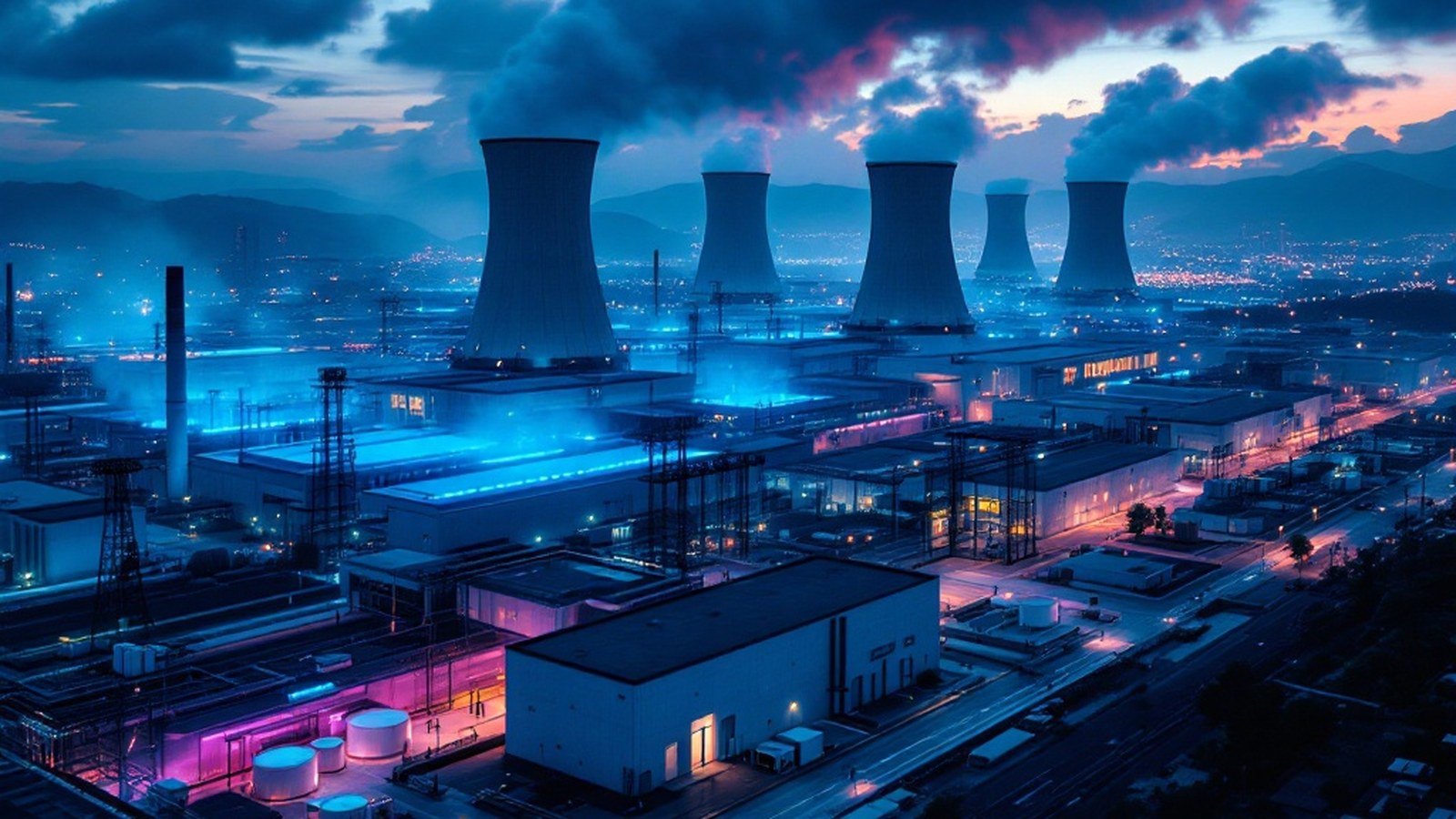
The Campus, the Hall, the Row
From the outside, the facility looks unremarkable: a low concrete structure on a grid-connected site, perhaps surrounded by cooling towers or, in colder climates, by open-air heat exchangers moving heat into the sky. What marks it as an AI training site rather than a conventional data center is mostly the scale of the power feed. A hyperscale cloud campus might be planned in phases of tens of megawatts; a serious training cluster demands a committed, stable block of power that can run continuously for weeks without interruption, because a training run that is cut short is largely wasted. Grid interconnection — securing that feed from the utility — is often the longest-lead constraint on the whole project, taking longer to arrange than designing and ordering the servers themselves.
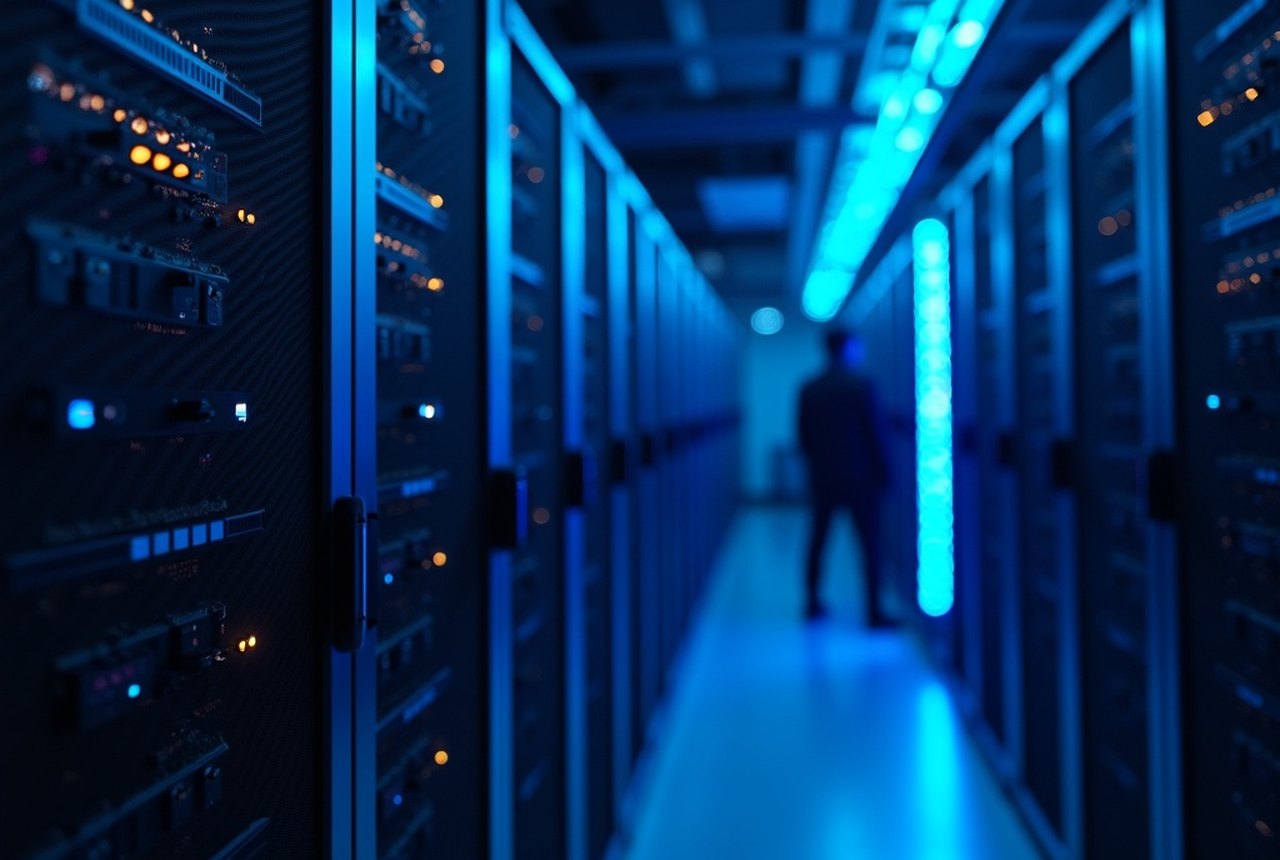
Inside, the building is a machine room: raised-floor or concrete slab, long rows of cabinets, a ceiling threaded with power bus bars and network cabling. The lighting is dim by human standards and the noise is relentless — though increasingly, the loudest sounds come not from server fans but from the hum of cooling infrastructure. AI racks running at 40 to 80 kW, sometimes higher, simply cannot be tamed by air. The cooling architecture reflects this: overhead manifolds run chilled water to direct-to-chip cold plates on every server, and the return lines carry that heat away to the building's central plant. Some facilities go further, submerging entire trays of hardware in dielectric fluid — immersion cooling — which removes heat with a thoroughness that air cannot approach. Either way, the thermal engineering is as consequential as the compute.
Walk down the row and you notice that the cabinets are grouped deliberately. A cluster is not a random collection of servers; it is built in structured pods, sometimes called islands, that reflect the topology of the network fabric connecting them. A pod might contain several dozen racks. The pods tile the floor. Understanding why this physical geography matters requires understanding the fundamental nature of the machine.

One Machine, Not Many
The central fact about a training cluster is that it is a single computer — not a collection of computers that happen to share a workload. When a large language model trains, the model and its data are partitioned across thousands of accelerators, and at each training step every accelerator must exchange gradient information with others before any of them can proceed. This is not optional coordination; it is the mathematical structure of distributed training. The implication is brutal: the cluster runs at the speed of its slowest synchronisation. One congested switch, one degraded link, one malfunctioning NIC, and tens of thousands of accelerators sit idle, waiting.
This is why engineers obsess over the network fabric with the same intensity they direct at the GPUs themselves. The dominant interconnect in large training clusters has historically been InfiniBand, which was designed from the ground up for low-latency, lossless transport — exactly the properties that gradient synchronisation demands. In recent years, purpose-built Ethernet variants carrying RDMA traffic (RoCE) have gained ground, and some hyperscalers have developed proprietary interconnects tuned specifically to their training workloads. The topology is typically a fat-tree or spine-leaf arrangement, engineered to deliver full bisection bandwidth — meaning any accelerator can exchange data with any other at line rate, without bottleneck, regardless of where in the building each sits. Achieving that at scale, across tens of thousands of ports, requires careful, layered switching fabric and meticulous cabling.
The speed of an all-reduce operation — the collective communication primitive that gathers gradients from every accelerator and distributes the averaged result back — scales with both the number of participants and the bandwidth available to each. You can have the fastest chips on the market and still starve them if the network cannot keep up. This is not an edge case or an engineering failure; it is the fundamental constraint the entire cluster is designed around.
The cluster runs at the speed of its slowest synchronisation.

The Rack and the Node
Zoom in to a single cabinet and the physical density becomes vivid. An AI server rack, at 42U, might hold eight compute nodes and the switches serving them, drawing 80 kW or more in sustained operation. The power delivery — busbars, power distribution units, redundant feeds — is engineered for continuous full load, not the statistical averaging that governs conventional enterprise racks. AI training does not have idle periods the way enterprise workloads do; when the cluster is running, every accelerator is running.
Each compute node is the fundamental unit of the cluster. In a typical high-end configuration, a node contains eight accelerators — GPUs or purpose-built AI chips — mounted on a backplane or carrier that also holds the CPU, large quantities of DRAM, high-speed local NVMe flash, and multiple network interface cards. The accelerators communicate with each other within the node over a dedicated high-bandwidth interconnect, such as NVLink in NVIDIA systems, achieving transfer rates that dwarf what any external fabric can offer. This is intentional: as much communication as possible is kept on-node, where it is fast and free. The inter-node fabric handles the rest.
The local NVMe flash serves a specific, critical purpose: checkpointing. A training run lasting weeks across ten thousand accelerators faces a non-trivial probability of at least one hardware failure. Rather than start over, the cluster periodically writes a checkpoint — a full snapshot of the model weights and optimizer state — to fast local storage. If a node fails, the run can restart from the last checkpoint rather than from scratch, losing only the work since the previous save. Checkpoint frequency is a balancing act: write too rarely and a failure is expensive; write too often and the checkpoint I/O itself imposes overhead. At the largest scales, parallel checkpoint libraries write to distributed storage across the cluster simultaneously, completing in seconds rather than minutes.
Feeding the Machine
An accelerator executing a training step needs data — batches of training examples — continuously. If the data pipeline cannot deliver fast enough, the accelerator stalls, and utilisation drops. Serious clusters therefore invest heavily in storage and ingestion infrastructure: high-throughput distributed file systems or object stores, optimised data loaders, preprocessing pipelines that stage data close to the compute before it is needed. The goal is to keep the accelerator's memory full and its math units busy. Any time the GPU is waiting — for data, for a gradient exchange, for a checkpoint write — is utilisation lost.
This is the deeper reason you cannot simply add more servers to make training faster. Scaling a training cluster is not an additive exercise; it is a systems problem. Every new accelerator added to the job must be fed data, kept synchronised with every other accelerator, and integrated into a communication pattern that grows in complexity with the cluster size. The bandwidth required for all-reduce operations scales with the number of participants. The probability that at least one component fails increases as you add components. The software must be partitioned and parallelised correctly — across tensor parallelism within a node, pipeline parallelism across nodes, and data parallelism across the broadest scale — or the hardware sits idle while synchronisation barriers pile up. Getting all of this right simultaneously, at the scale of tens of thousands of accelerators, is what separates a training cluster from a data center that merely contains many GPUs.
The Building as a Single Processor
Step back to the campus view again, and the logic coheres. The site's power feed, the cooling plant, the raised-floor topology, the cable routes, the network pods, the racks, the nodes, the accelerators — each layer is engineered to serve the one below and constrain the one above. PUE, the ratio of total facility power to IT power, reflects how efficiently the building converts electricity into useful computation; a well-run AI data center targets a PUE of 1.1 to 1.2, meaning the overhead of cooling and power conversion is kept to ten or twenty percent of the IT load. Every watt wasted in an inefficient chiller or an oversized UPS is a watt that could have been delivered to an accelerator.
The physical scale is new, but the conceptual model is old: a supercomputer. The HPC community has spent decades building tightly coupled, synchronised machines at large scale, and the AI training cluster is that tradition continued — with higher rack densities, more aggressive network fabrics, and a cooling challenge that has forced a fundamental rethink of what a data center is. Today's training cluster is a building-sized processor. Its performance is not a function of any single chip; it is a function of how well every layer, from the grid connection to the NVLink domain, is engineered to serve the collective whole.